

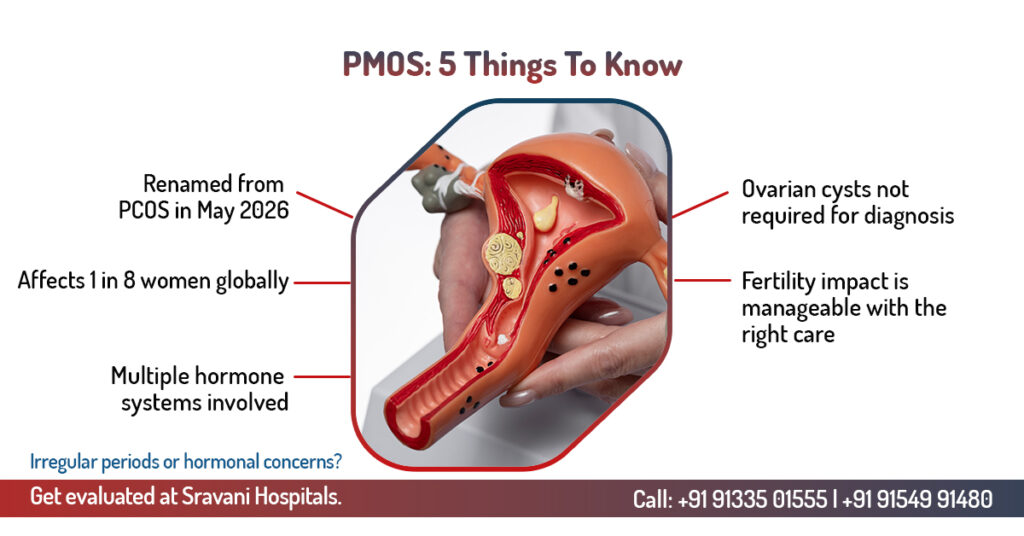
PCOS was the wrong name. It pointed to cysts on the ovaries as the main feature. But many women with this condition never had cysts. Up to 70% of those women remain undiagnosed, according to the WHO and a misleading name was part of the problem.
On May 12, 2026, The Lancet published a global consensus backed by 56 medical and patient organisations, with input from over 14,000 people, officially renaming PCOS to PMOS: polyendocrine metabolic ovarian syndrome.
At Sravani Hospitals the gynaecology team has been seeing women with irregular cycles, hormonal concerns and PCOS-related symptoms since 2022. Our department includes Senior Consultants with MD and DOO qualifications, laparoscopic surgeons, fertility specialists and sonologists.
Hormonal blood tests, pelvic ultrasound and cycle evaluation are also done in-house, so patients leave the first appointment with a clear picture of why PCOS became PMOS : symptoms, causes, fertility.
What Is PMOS And Why Did The Name Change?
PMOS is a more accurate name. The old name was built around the idea of cysts on the ovaries. But the real picture is much wider.
PMOS is a hormonal condition that affects the whole body. The word “polyendocrine” means several hormone systems are involved at once: insulin, androgens, and the brain’s signals to the ovaries.
“Metabolic” points to how the condition affects weight, blood sugar and long-term heart health. It can involve hormones, periods, skin, hair growth, weight, fertility, blood sugar, heart health and emotional wellbeing.
What Actually Causes PMOS?
PMOS develops from a mix of hormonal and metabolic factors. They overlap differently in every woman. That’s why no two cases look the same. The main factors:
- Family history : Women with a mother or sister with PCOS, irregular periods or type 2 diabetes are at higher risk.
- Body weight : Carrying extra weight can make insulin resistance worse.
- Disrupted signals : The communication between the brain and ovaries goes off balance.
- Insulin resistance : The body needs more insulin than usual, which pushes the ovaries to make more androgens (male hormones)
- Elevated androgens : Too much testosterone disrupts ovulation and affects skin and hair.
These factors don’t work in isolation. In one woman, insulin resistance is the main driver. In another, genetics plays a bigger role. That’s why the treatment approach can’t be the same for everyone.
What Symptoms Should You Watch For?
PMOS symptoms vary from person to person. Some women have several obvious signs. Others have just one or two that they never connect to a hormonal condition. The ones worth paying attention to:
- Periods that come late, arrive unpredictably or stop for months
- Heavy bleeding when periods do come
- Acne that keeps returning, especially along the jaw and chin
- Facial or body hair that feels out of the ordinary
- Hair thinning on the scalp
- Weight that is hard to lose
- Difficulty getting pregnant after trying for several months
Worth noting: If two or more of these have been affecting you for more than three months, a gynaecology consultation at Sravani Hospitals : one of the most accessible options for a best gynecologist in Kukatpally can help work out what’s going on.
How Does PMOS Affect Your Fertility?
PMOS affects fertility mainly through ovulation. When hormones are off balance, ovulation becomes irregular or stops. Without a released egg, pregnancy can’t happen naturally.
Most women with PMOS can still get pregnant. What helps with fertility planning is:
- Getting evaluated early matters as it opens more treatment options
- Even a small reduction in body weight, around 5 to 10%, can restore ovulation in some cases.
- Ovulation can be tracked with monitoring, and in some cases supported with medicine based on doctor evaluation.
- If natural conception hasn’t happened after a reasonable period of trying, assisted options can be explored .
A fertility-linked gynaecology evaluation at Sravani Hospitals looks at ovulation patterns, hormonal blood tests and ultrasound findings together before recommending anything.
How Is PMOS Diagnosed And Treated?
PMOS is diagnosed when at least two of three criteria are present: irregular periods, elevated androgen levels, or excess follicles on ultrasound. A single ultrasound isn’t enough on its own.
| What doctors look for | How it is confirmed |
|---|---|
| Irregular or absent periods | Clinical history and cycle tracking |
| Elevated androgens | Blood tests or visible symptoms like excess hair, acne |
| Excess follicles on ultrasound | Pelvic scan showing more than 20 follicles in one ovary |
Treatment depends entirely on what’s affecting the patient most. There is no standard plan.
| Main concern | General treatment direction |
|---|---|
| Irregular periods | Lifestyle changes, hormonal support where appropriate |
| Acne or excess hair | Androgen management, based on test results |
| Insulin resistance or weight | Dietary guidance, medical support |
| Fertility | Ovulation monitoring, possible induction |
| Long-term diabetes or heart risk | Metabolic screening and follow-up |
PMOS usually needs long-term management. Symptoms can return when lifestyle changes stop. The right approach by any best gynecologist near me for a 22-year-old looks very different from the approach for a 32-year-old trying to conceive.
Get A Proper Evaluation By A Gynecologist In Kukatpally At Sravani Hospitals
Irregular periods, unexplained acne, weight changes or trouble conceiving ? A proper hormonal evaluation is the first step.
Sravani Hospitals has a dedicated gynaecology team and department which includes fertility specialists, laparoscopic surgeons and sonologists working under one roof. Tests are ordered only when clinically needed, not by default. Treatment is explained clearly before anything begins.
We are also one of the most accessible options for the best gynecologist in Hyderabad, with branches open 24 hours, seven days a week at both KPHB and Madhapur.
Call: +91 91335 01555 | +91 91549 91480
Frequently Asked Questions
Is PMOS the same as PCOS?
Yes. Same condition, new name. Your existing diagnosis stays valid. No repeat tests are needed because of the name change.
Do you need ovarian cysts to be diagnosed with PMOS?
No. Cysts are not required. Diagnosis needs at least two of three criteria: irregular periods, elevated androgen levels, or excess follicles on ultrasound. Many women with PMOS have no visible follicles on scan at all.
Can women with PMOS still get pregnant?
Most can, yes. Irregular ovulation makes natural timing harder, but it doesn’t make pregnancy impossible. With the right evaluation and, in some cases, targeted medical support, many women with PMOS conceive without needing complex fertility treatment.
What tests confirm PMOS?
The gynaecologist looks at three things together: your cycle history, a blood test panel checking hormone levels, and a pelvic ultrasound. LH and FSH are hormones that regulate the menstrual cycle. Testosterone tells the doctor how much androgen activity is present. No single test confirms PMOS on its own.
Has treatment changed since the name changed?
No. The treatment approach stays the same. Lifestyle changes, hormonal support, fertility planning and metabolic monitoring are still the core. What the name change does is help doctors and patients see the full condition.