

Knee arthritis does not only cause pain. It slowly changes how you walk, climb stairs, and plan simple parts of the day. When knee replacement enters the discussion, most patients do not just want surgery advice. They want to know which option will benefit them more: partial or total knee replacement.
The answer depends on how much of the knee is damaged, how stable the joint is, and what the scans show. Partial knee replacement can offer a more natural knee feel and faster recovery in selected cases, while total knee replacement gives broader and more reliable relief when arthritis affects more than one part of the joint.
At Sravani Hospitals, an orthopedic hospital in Madhapur, orthopaedic decision-making is guided by clinical evaluation, imaging, and recovery planning so patients understand not only the surgery type, but also why it suits their knee.
This guide by the specialists provides the partial vs. total knee replacement | pros & cons explained, who each option suits, and what to ask before deciding.
Partial Vs Total Knee Replacement: Pros & Cons
Partial knee replacement is beneficial when arthritis is limited to one compartment and the rest of the knee remains healthy and stable. Total knee replacement becomes more beneficial when arthritis is widespread, the knee is stiff or deformed, or pain is not limited to one side.
For many patients, the real question is not which surgery sounds smaller. It is which option gives safer, longer-lasting relief for the actual condition of the knee.
Partial Replacement Pros You Should Understand
- Smaller area of resurfacing, which can mean less tissue disruption.
- Recovery can feel quicker for many eligible patients.
- More natural knee feel compared to total.
Cons You Should Be Clear About
- Eligibility is strict. If arthritis exists in multiple compartments, partial often fails to give durable relief.
- It needs precision. If alignment and selection are off, pain can persist or arthritis can progress.
- You may need conversion to total later if other compartments wear out.
Remember partial knee replacement is not a shortcut. It is the right choice only when your knee fits the criteria. Search for the best orthopaedic hospital near me if arthritis is clearly limited to one part of the knee.
Total knee replacement offers better long-term relief when the knee has deformity, stiffness, or instability. In these cases, a broader resurfacing approach can be a safer and more reliable option.
Total Knee Replacement Benefits You Should Know
- Treats multi-compartment arthritis and broader cartilage loss.
- More reliable when deformity or stiffness is significant.
- Often the safer option when the knee is unstable.
Cons You Should Be Clear About
- Recovery can feel slower than partial because the surgery changes more joint surfaces.
- Rehab needs consistent effort for best bending, walking confidence, and endurance.
- Some people say the knee feels different early on, even when pain relief is strong.
If your scan by the best orthopedic hospital in Madhapur shows widespread wear, choosing total knee replacement can prevent repeated cycles of pain and half-measures later.
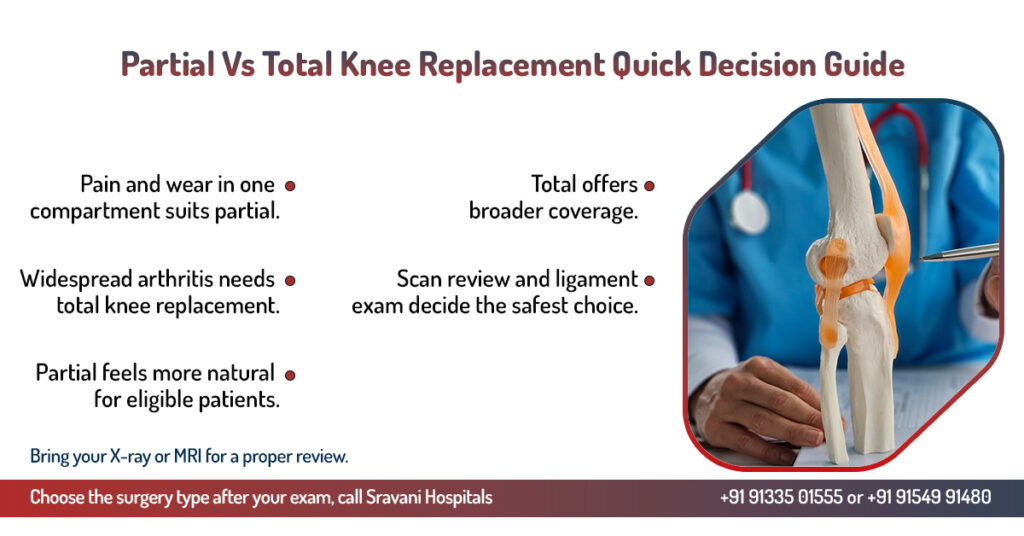
What Is The Difference Between Partial And Total Knee Replacement?
Partial knee replacement replaces one damaged compartment, whereas total replaces the full joint surface, and the decision depends on where your arthritis sits and how stable your knee is.
| Point | Partial Knee Replacement | Total Knee Replacement |
| Area treated | One compartment | Whole joint surface |
| Best for | Isolated wear with stable knee | Widespread wear or deformity |
| Recovery feel | Often quicker in eligible cases | Steady, longer rehab curve |
| Main risk | Arthritis progresses elsewhere | More tissue resurfacing |
The phrase partial vs. total knee replacement | pros & cons explained matters when you connect it to your scan and exam, and not to a generic checklist.
Who Is A Better Fit For Partial Vs Total Knee Replacement?
Partial knee replacement suits isolated arthritis with good ligament stability, while total suits multi-compartment arthritis, deformity, or unstable knees. Doctors look at:
- Which compartment shows cartilage loss on X-ray or MRI?
- Whether ligaments keep the knee stable during exams?
- Whether the knee has significant bowing, stiffness, or damage on both sides.
- Does pain come from one side or feels widespread?
Often a better fit for Partial Knee Replacement
- Pain on one side of the knee.
- Good range of motion.
- Stable ligament exam.
- Damage limited to one compartment on imaging.
Often a better fit for Total Knee Replacement
- Pain across the knee, not limited to one side.
- Noticeable deformity or stiffness.
- Multi-compartment wear on imaging.
- Instability that affects walking confidence.
Book An Orthopaedic Consultation At Sravani Hospitals In Madhapur
If you feel stuck between options, do one thing. Get a scan-based opinion and a written plan. That is what turns confusion into clarity.
Sravani Hospitals, the best orthopedic hospital in Madhapur, patients can get orthopaedic evaluation, imaging-led decision support, and a treatment plan that explains clearly why partial or total knee replacement is being advised.
Dr. Swaroop Chandra and Dr. Shiva Kanth Manthri with expertise in joint replacement, minimally invasive orthopaedic procedures, and post-operative rehabilitation, the focus stays on helping patients choose the option that is safest and most suitable for their knee.
If you are comparing the best orthopaedic hospital near me ask a clear explanation of why partial or total fits your knee, and a rehab plan you can actually follow. To book an appointment, call +91 91335 01555.
FAQs
Is Partial Knee Replacement Always Better Than Total?
No. Partial is better only when wear is isolated and the knee stays stable. Total is often safer when arthritis is widespread.
Does Partial Knee Replacement Recover Faster?
Often yes for eligible patients, because less of the knee is resurfaced. Some clinical and hospital sources describe quicker recovery patterns for partial compared to total in suitable cases.
Can A Partial Knee Replacement Be Converted To Total Later?
Yes. If arthritis progresses in other compartments or symptoms persist, conversion to total can be needed in some cases.
How Do Doctors Decide If I Qualify For Partial?
They rely on X-rays, sometimes MRI, and a stability exam to confirm that only one compartment is damaged and ligaments are functioning well.
What Should I Bring To The Consultation?
Bring your X-ray or MRI, prior prescriptions, and a short note on where pain happens, what worsens it, and how far you can walk.