

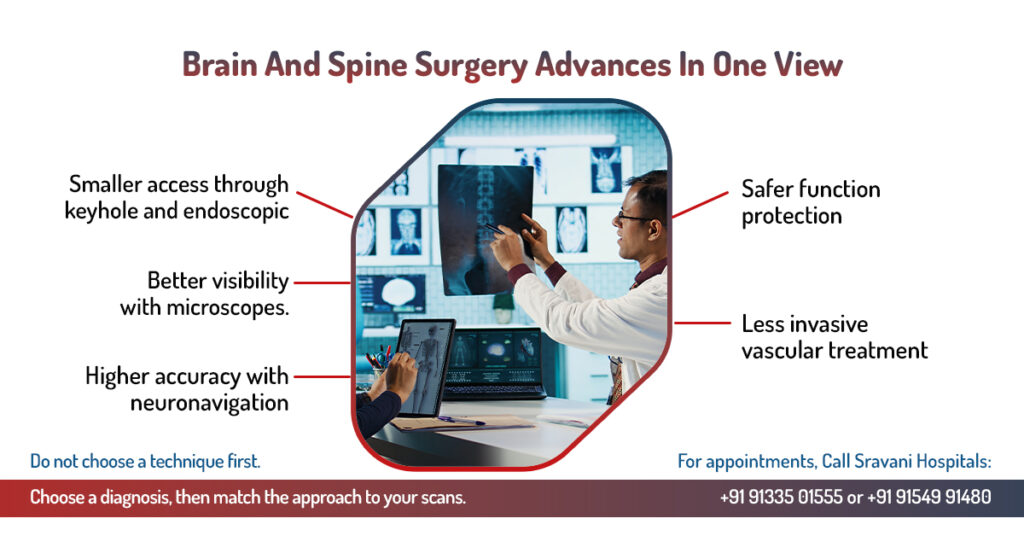
Advancement in brain and spine surgery means surgeons can reach through smaller access points, see critical structures more clearly, and protect function better during high-risk procedures. These upgrades do not remove risk, but they often improve precision and recovery in the right patient.
If you want a starting point, begin with a neurologist in Kukatpally who can confirm diagnosis, review scans, and guide next steps. Sravani Hospitals runs a neurology department in Madhapur and supports booking for report reviews and follow-ups.
This guide by our expert breaks down the biggest brain and spine surgery breakthroughs, who benefits most, and what to ask before you agree to any procedure.
What Are The Biggest Advancements In Brain Surgery?
Brain surgery has become safer and more precise because surgeons can see better, reach through smaller access points, and protect critical brain functions more reliably.
Keyhole And Endoscopic Brain Surgery
Keyhole and endoscopic brain surgery use smaller openings and camera systems to reach deep areas with less tissue handling in some cases. It can reduce pain, blood loss, and hospital stay. But it still needs careful planning, skilled teams, and the right case selection.
5-ALA “Glow” Dye In Tumour Surgery
Some brain tumours become easier to separate from normal tissue using fluorescence guidance. 5-ALA is a dye that can make certain tumour cells glow under special light, which helps surgeons see margins more clearly during surgery. 5-ALA can increase the chance of more complete tumour removal in high-grade glioma surgery. This is not used for every tumour, and it depends on tumour type and centre protocols.
Navigation And Real-Time Imaging During Surgery
Neuronavigation works like GPS for the surgeon. It uses your scans to guide the surgical path in 3D. Intraoperative imaging, such as MRI or CT-based systems, can also help neurologist in Hyderabad re-check position during the operation and adjust if anatomy shifts.
Awake Surgery And Brain Mapping Near Speech Or Movement Areas
Awake craniotomy sounds scary, but the reason is simple. When a tumour sits near movement centres, surgeons can map function during surgery and reduce the risk of damaging critical areas. The patient does not feel pain from the brain itself. The best neuro hospital in Hyderabad team focuses on comfort, monitoring, and short tasks when needed.
Treating Aneurysms And AVMs Without Open Surgery
Many aneurysms and some AVMs can be treated through blood vessels using endovascular techniques such as coiling, stent-assisted coiling, or flow diversion. The key advantage is that some patients avoid open brain surgery when anatomy and risk profile allow it. A specialist from the best neurology hospital in Hyderabad decides this based on scan findings and rupture risk.
Deep Brain Stimulation For Movement Disorders
DBS is a major advancement for conditions like Parkinson’s disease and essential tremor. Electrodes placed in specific brain targets help modulate abnormal signals. DBS can reduce tremor and improve motor fluctuations in selected patients, but it does not “cure” the disease. It works best when the diagnosis is correct.
If you are trying to choose the best neurology hospital in Hyderabad, note that advanced options do exist, but the safest plan starts with correct diagnosis and case selection.
What Are The Advances In Spine Surgery That Help Patients Recover Faster?
Spine surgery has moved from large cuts to muscle-sparing approaches and precision-guided fixation in many suitable cases. Some of the developments in spine surgery that help patients recover faster are:
Minimally Invasive And Endoscopic Spine Surgery
Minimally invasive spine surgery uses smaller incisions and muscle-sparing corridors to reach the spine. Endoscopic spine surgery uses a camera system to treat selected disc and nerve compression problems through very small access points. Many patients recover faster when the case fits, but endoscopy does not suit every spine problem. Severe instability, major deformity, or complex multi-level disease still need open approaches.
Robot Guided Spine Surgery For Higher Accuracy
Robots do not do the surgery alone. They help with planning and guidance, especially for placing screws in complex anatomy. When the trajectory is accurate, it lowers the chance of malposition and reduces rework. This can improve safety in selected fixation cases.
Image Guidance During Spine Fixation
Navigation and intraoperative imaging help the best neuro hospital in Hyderabad confirm placement in real time, when anatomy is distorted or revision surgery is involved. This is one of the quiet upgrades that patients do not see, but surgeons value because it improves precision.
Modern Spine Options Patients
Pedicle screw fixation systems stabilise the spine when instability or deformity exists. Artificial disc replacement preserves motion in selected cases, but it is not suitable for everyone.
Who Is Most Likely To Benefit From These Neurosurgery Advancements?
The best technique depends on diagnosis, location, anatomy, and safety, not on what sounds newest. Patients benefit most when the problem is well-defined on MRI or CT and fits a targeted approach. Also if the lesion sits in a location where navigation, mapping, or endoscopy offers a safer corridor. Or the care plan includes rehab and follow-up, not just the operation date.
Book A Neurology Opinion At Sravani Hospitals In Hyderabad
If you are reading about advancement in brain and spine surgery, the smartest first step is a neurology opinion with a proper scan review. A neurologist helps confirm what the report means, what is urgent, what can wait, and whether you even need surgery or only monitoring and medicines.
Sravani Hospitals has a dedicated neurology service and invites patients to share symptoms and duration for faster routing, which helps when you need a clear plan without delay.
With EEG as a commonly advised test for seizure evaluation and blackout-like episodes, the team can move from symptoms to a clear diagnosis instead of guesswork.
Dr. Rahul Reddy, with 15+ years of experience and Dr. Pachipala Sudheer, a Consultant Neurologist with DM Neurology (AIIMS, New Delhi) helps you understand which advanced approach fits your case. To book an appointment, call: +91 91335 01555 or +91 91549 91480.
FAQs
Is Neurology and Neurosurgery the Same?
Neurology focuses on diagnosis and medical management of brain, nerve, and spine disorders. While neurosurgery performs surgical treatment when needed.
Does Minimally Invasive Mean Faster Recovery?
Through minimally invasive, many people recover faster, but only when the diagnosis and anatomy fit. Some conditions still need open surgery for safety.
Is Robotic Spine Surgery Performed Entirely By A Robot?
No, the surgeon performs the spine surgery and the robot helps with planning and guiding precise screw trajectories in selected cases.
What Does 5-ALA Do In Brain Tumour Surgery?
5- ALA helps certain tumour cells glow under special light so the surgeon can see tumour margins more clearly during surgery.
When Is Awake Brain Surgery Considered?
Doctors consider awake brain surgery when a tumour is close to speech or movement areas and mapping can help protect function.
What Should I Bring To A First Neurology Visit?
Bring scan reports, old prescriptions, and a short symptom timeline on your first neurology visit. It helps the doctor connect your symptoms to imaging.