

For many people knee pain begins with a small twist on stairs, a pop during sport, or an ache that keeps returning. Then the mind thinks, Is it serious? Will it heal?
The most common knee injuries involve ligaments, tendons, kneecap tracking, and sometimes bone. Prevention comes down to better strength, movement control, and not overloading the knee when your body is tired.
Sravani Hospitals’ orthopaedics team treats knee pain and injuries with a clear, diagnosis-first approach. The team includes an arthroscopy and joint replacement consultant, which is relevant when knee instability or locking needs specialist evaluation. If you are looking for an orthopedic hospital in Madhapur, you can choose Sravani Hospitals for orthopaedic care.
This guide covers knee injuries – symptoms, treatments and causes, what you can do to prevent common injuries and when to seek medical help.
What Are The Most Common Knee Injuries?
The most common knee injuries include ligament sprains or tears, meniscus tears, kneecap dislocation and fractures after a major fall or impact.
Ligament sprains or tears (ACL, MCL, others)
A ligament injury happens with a twist, or awkward landing. People describe a pop or sudden shift. Swelling can show up and the knee may feel unstable. Treatment at the best orthopedic hospital in Hyderabad starts with swelling control and rehab. Some ligament tears need surgery, especially in active people with instability.
Meniscus tear
Many people call it cartilage tear. Meniscus tears cause pain on twisting, catching, or locking. Swelling may come and go. Treatment includes rehab and activity changes. And some tears need arthroscopy when locking or ongoing pain continues.
Kneecap issues (patellar dislocation or tracking pain)
Patellar dislocation happens during sport or sudden direction change. Tracking pain feels like aching at the front of the knee, worse on stairs or long sitting. Rehab by the best orthopedic hospital in Madhapur focuses on thigh and hip strength and movement control.
Tendon and overuse problems
Patellar tendinitis happens when repeated stress causes tiny tendon tears and irritation.
This is common in jumping sports, running spikes, and sudden training increases.
Bursitis and inflammation around the knee
You may feel swelling and tenderness over a specific spot, after kneeling work or repeated friction. Rest and inflammation control helps many cases of bursitis and inflammation.
Fractures and dislocations
Fractures or dislocations follow a fall, accident, or heavy impact. Get it treated at the best orthopaedic hospital near me urgently because walking on them can worsen damage.
| What do you notice? | What does it suggest? | What to do first? |
| Pop with fast swelling within hours | ACL type injury pattern | Stop sport, ice, compression, get examined soon |
| Locking or catching, pain on twisting | Meniscus tear pattern | Avoid squats, avoid twisting, book an ortho review |
| Knee gives way on stairs | Ligament or meniscus instability | Do not ignore, get assessed |
| Pain at front of knee on stairs or sitting | Patellofemoral pain pattern | Modify activity, strengthen hips and quads |
| Pain below kneecap after jumping or running | Patellar tendon overload | Reduce load, start rehab, avoid jumping |
| Severe pain after fall, cannot bear weight | Fracture or major injury | Same day evaluation |
How Do You Prevent Common Knee Injuries?
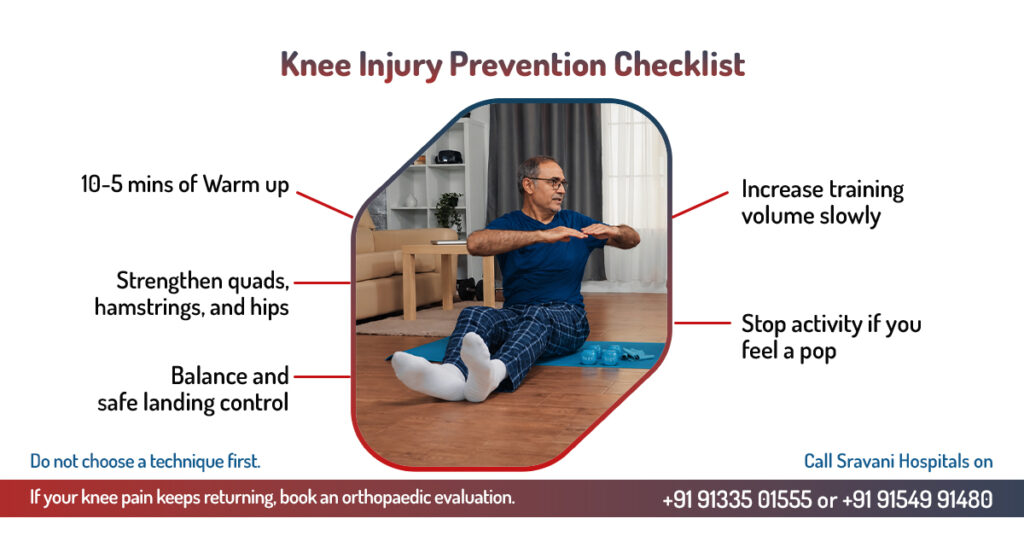
Knee injury prevention works when you build strength, improve balance, landing control, and increase training load slowly. Most injuries happen when the knee takes more load than it can control. Prevention is not only stretching, but is about better movement and better support from muscles.
What helps most, in real life?
- Warm up: 5 to 10 minutes of light movement before sport along with a few controlled squats and lunges.
- Train the hips and thighs: Strong glutes and quads reduce knee collapse during running and stairs.
- Build hamstring strength: It supports knee stability, in most of the sports.
- Practice balance and control: Single-leg balance, slow step-downs, and controlled hops improve knee control.
- Increase training gradually: Sudden running jumps and sudden jump training trigger overload injuries.
- Respect pain signals: Pain that changes your walking pattern is asking you to stop and reset.
A simple prevention habit that works for busy people is this: if you only do two exercises, do a controlled step-down and a hip bridge, three times a week. It improves control without taking an hour.
When Should You Seek Medical Help For A Knee Injury?
Seek medical help if you cannot bear weight, have severe swelling, hear a pop, restricted movement, or suspected fracture. These are not wait and watch situations. Book an evaluation if:
- Pain lasts more than 7 to 10 days even after rest.
- The knee keeps swelling after activity.
- You feel instability, like the knee might buckle.
- Locking stops you from bending or straightening fully.
This is where early care helps. Small injuries become bigger when people keep playing through them. If you are choosing the best orthopedic hospital in Madhapur, look for a place that does a proper clinical exam first and then guides tests if needed, instead of sending you straight into a long list of investigations.
Book A Knee Injury Consultation At Sravani Hospitals In Madhapur And Hyderabad
If knee injuries – symptoms, treatments and causes, start limiting your walk, your stairs, or your sport, it is worth getting a proper diagnosis instead of patching it with rest every time. Sravani Hospitals, orthopedic hospital in kukatpally provides accurate diagnosis, clear treatment plans, and recovery support, which matters for knee injuries because rehab needs structure.
Dr. Shiva Kanth as a Consultant Trauma, Arthroscopic, and Joint Replacement Surgeon, aligns with common knee injury evaluation and arthroscopy-led care when needed. So if you are searching for the best orthopedic hospital in Hyderabad because your knee keeps giving way, start with a consult and a clear plan. Sravani’s Madhapur access makes follow-ups easier when rehab needs multiple check-ins.Thus, the best orthopaedic hospital near me with a written recovery plan and a timeline you can follow. Call Sravani Hospitals on +91 91335 01555 or +91 91549 91480 to book an appointment.
FAQs
What is the most common knee injury in sports?
Ligament sprains and meniscus tears are very common, especially after twisting or pivoting.
How do I know if I tore my ACL or meniscus?
An ACL pattern often includes a pop and fast swelling. A meniscus pattern often includes locking, catching, or pain on twisting. A doctor confirms it with an exam and imaging if needed.
Should I walk on a swollen knee?
If you cannot bear weight or swelling is severe, avoid walking on it and get checked. Sravani lists inability to bear weight and severe swelling as reasons to seek orthopaedic care.
Does a knee brace help?
A Knee brace supports certain injuries only for short term, but it does not replace rehab.
What is the best way to prevent knee injuries?
Hip and thigh strength, warm up, and increase training volume gradually to prevent knee injuries.