

Your knee does a lot more than bend and straighten. It carries your body weight, helps you climb stairs, lets you run, supports sudden turns and keeps your leg balanced during everyday movement. The 4 major ligaments of the knee, ACL, PCL, MCL and LCL, make all this possible.
When one of these ligaments gets stretched or torn, you may feel pain, swelling, weakness or a sudden giving-way sensation. Some people hear a pop during injury. Others feel the knee becoming unstable over a few hours.
Sravani Hospitals, an orthopedic hospital in Madhapur, knee ligament problems are assessed through digital imaging, clinical examination, and recovery planning. The goal is to name the injury and understand how badly the knee is affected and suggest which treatment will offer the safest recovery.
This guide explains the major ligaments of the knee: injuries & treatment, their function, common symptoms and when you should visit an orthopaedic doctor.
What Are The Major Ligaments Of The Knee Joint?
The knee joint has 4 major ligaments used to connect the thigh bone to shin bone, keeping the joint stable during rotation and movements.
These ligaments are ACL, PCL, MCL and LCL. Each one controls a different type of movement. Together, they stop the knee from sliding too forward, backward or sideways.
- The ACL, or anterior cruciate ligament, sits inside the knee and controls forward movement of the shin bone. It also helps during twisting movements.
- The PCL, or posterior cruciate ligament, also sits inside the knee. It stops the shin bone from moving too far backward. PCL injuries often happen after a strong blow to the front of the knee, such as a dashboard injury during an accident.
- The MCL, or medial collateral ligament, supports the inner side of the knee. It protects the knee when force pushes it inward. This injury is common during side impact or sports collisions.
- The LCL, or lateral collateral ligament, supports the outer side of the knee. It protects the knee from outward stress and helps maintain side-to-side balance.
So, when you consult the best orthopedic hospital in Madhapur, they will first try to identify which ligament is damaged and how much stability the knee has lost.
What Is The Function Of Each Knee Ligament?
Each knee ligament has one particular job that is to stop unsafe movement and keep the knee aligned when you walk, twist , bend, or put weight on the leg.
- The ACL protects the knee during sudden direction changes. If you twist while running or land badly the ACL activates.
- The PCL protects the knee from backward force. It helps when you walk downhill, bend the knee or control the leg during deeper movements.
- The MCL protects the inner side of the knee. Whereas, the LCL protects the outer side of the knee.
A knee injury often needs a proper exam at the best orthopedic hospital in Kukatpally because ligaments work with muscles, tendons and cartilage.
Common Knee Ligament Injuries And What They Feel Like
Knee ligament injuries can feel different depending on the ligament involved, but pain, swelling and instability are common warning signs.
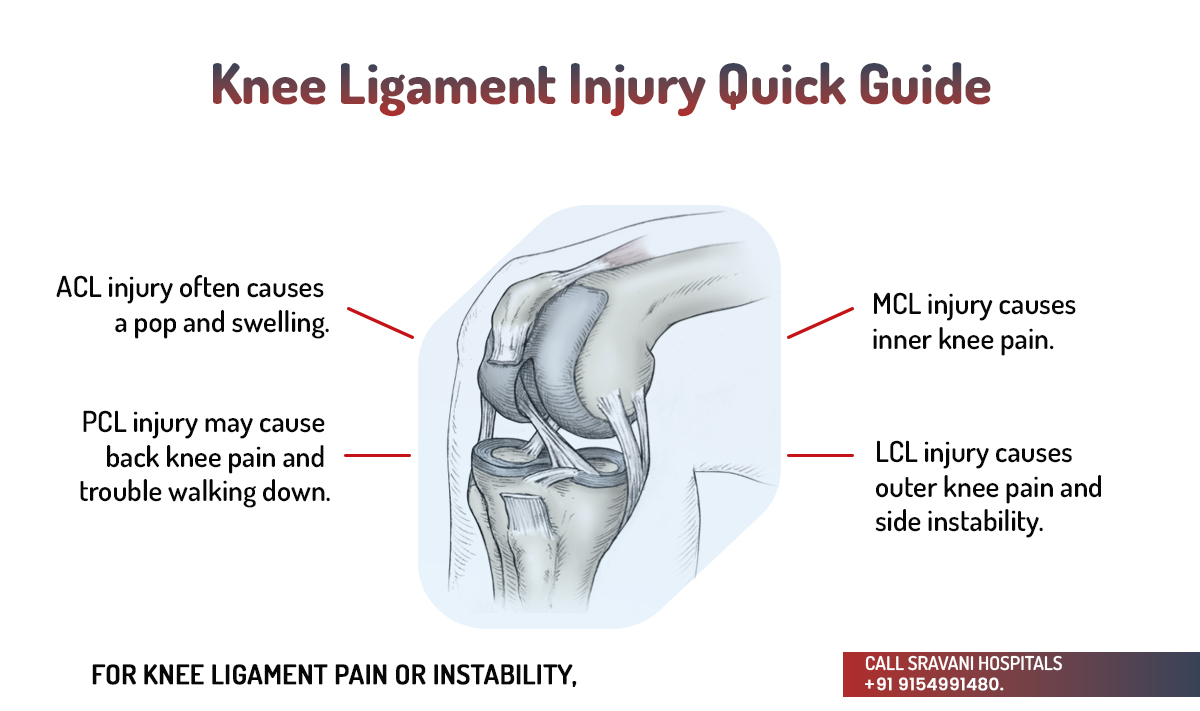
- An ACL injury often happens suddenly. You may hear or feel a pop inside the knee. Swelling can develop quickly. This injury is common in football, badminton, running, jumping and sudden pivot movements.
- A PCL injury may feel more subtle. Pain is often felt at the back of the knee. Walking downstairs or downhill may feel uncomfortable because the knee does not feel fully controlled.
- An MCL injury usually causes pain on the inner side of the knee. The area may feel tender to touch. You may feel pain while bending, walking or changing direction.
- An LCL injury causes pain on the outer side of the knee.
You should not judge the injury only by pain level. Some serious ligament injuries may allow you to walk at first, but the knee may stay unstable. That instability can damage other structures over time.
What Causes Knee Ligament Injuries?
Knee ligament injuries mostly occur when the knee moves beyond its safe limit or receives sudden force.The most common causes are:
- Sports injuries.
- A sudden stop, twist, fall or wrong landing.
- Weak thigh and hip muscles increases the risk.
- Road traffic accidents.
- Poor footwear, uneven surfaces and sudden activity also add risk.
This is why major ligaments of the knee: injuries & treatment, does not stop at pain relief. A good plan also checks strength, movement, balance and the reason the injury happened.
Treatment Options For Knee Ligament Injuries
Treatment for knee ligament injuries depends on the ligament involved, the grade of tear and how unstable the knee feels. Mild ligament sprains may not need surgery. Rest, ice, compression and elevation can help reduce swelling in the first few days.
- A knee brace may support the joint and prevent unsafe movement while healing begins.
- Medicines may help control pain and swelling, but they do not repair the ligament by themselves. You should avoid repeated painkiller use without a diagnosis,
- Physiotherapy is one of the most important parts of recovery. It helps restore knee bending, muscle strength, balance and walking confidence.
- Some partial tears heal well with non-surgical treatment. This is more common when the knee stays stable and the patient follows activity restrictions properly.
- Surgery may be advised when the ligament is completely torn, the knee keeps giving way or the patient wants to return to sports or heavy physical activity.
Modern ligament surgeries at an orthopedic hospital in Madhapur, often use minimally invasive arthroscopic techniques. This means smaller cuts, better joint view and focused repair.
When Should You Visit An Orthopaedic Doctor For Knee Ligament Pain?
You should visit an orthopaedic doctor if knee pain comes with swelling, instability or difficulty walking.
Do not wait if you hear a pop during injury. This can be a sign of an ACL tear or another internal knee injury. You should immediately get checked if the knee swells within a few hours.
You should also consult the best orthopedic hospital in Hyderabad if you cannot fully bend or straighten the knee. Locking, catching or sharp pain may suggest meniscus or cartilage involvement.
Book A Knee Ligament Consultation At Sravani Hospitals In Madhapur
If your knee is swollen, unstable, or feels painful, do not keep waiting. A scan-based orthopaedic opinion can help you understand whether it is a mild, partial tear or complete ligament injury.
Sravani Hospitals, an orthopedic hospital in Madhapur, provides orthopaedic evaluation for knee pain, ligament tears , sports injuries,and joint instability. The expert team here focuses on clinical examination, imaging review, treatment planning and guided recovery. And the treatment includes medicines, physiotherapy, arthroscopy, bracing or ligament reconstruction as per your case or injury.
To book an orthopaedic consultation at Sravani Hospitals, call +91 9154991480.
Frequently Asked Questions
Can a knee ligament injury heal without surgery?
Yes, mild sprains and some partial tears can heal with rest, bracing and physiotherapy. Complete tears or unstable knees may need surgery.
Is walking safe with a knee ligament injury?
Walking may be safe in mild injuries, but avoid strain if the knee feels unstable. Get checked before returning to sports or heavy work.
Which scan is best for knee ligament tear?
MRI is usually the best scan for knee ligament tears. It shows ligament damage, swelling and related meniscus injury.
How long does knee ligament recovery take?
Mild injuries may recover in a few weeks. Surgery cases can take several months, especially when sports return is the goal.